Beyond the hype of Enterprise AI Transformation: A practical blueprint for building the AI-driven Life Sciences enterprise
Enterprise AI - led Transformation: Challenges and Opportunities
Challenges in realizing enterprise AI-value: AI and Generative AI are becoming a cornerstone of every enterprise digital strategy, but many organizations are finding that implementing holistic AI at scale for sustainable benefits is easier said than done. In 2025, enterprise AI adoption was at an all-time high, with surveys showing that over 80% of companies are using or exploring AI. However, only a small percentage of companies are beginning to deliver meaningfully on their promise — and many are continuing to succumb to “death by a thousand pilots.”. Some of the key reasons include:
-
Lack of a holistic AI-led business and digital strategy combined with initiatives that are aligned to strategy and have a razor focus on business outcomes
-
Limited governance and concerns regarding traceability, hallucination and other compliance guidelines required by the FDA and other agencies
-
Need for organizational change management and Strategic Workforce planning (recruitment, training and Human-in-the-loop (HTIL) oversight)
Opportunities: Enterprises need an overarching enterprise AI & digital strategy, desired business outcomes / KPIs, customized digital operation models, structured governance, RACI and forums, AI-Strategic Workforce Planning (DSWP), and change management to ensure realization of the true transformation benefits
LS-SACS Approach and Services
LS-SACS has developed a comprehensive set of proven methodologies to ensure life sciences companies - whether small, medium or large - realize the true benefits of Ai-led transformation in a sustainable manner.
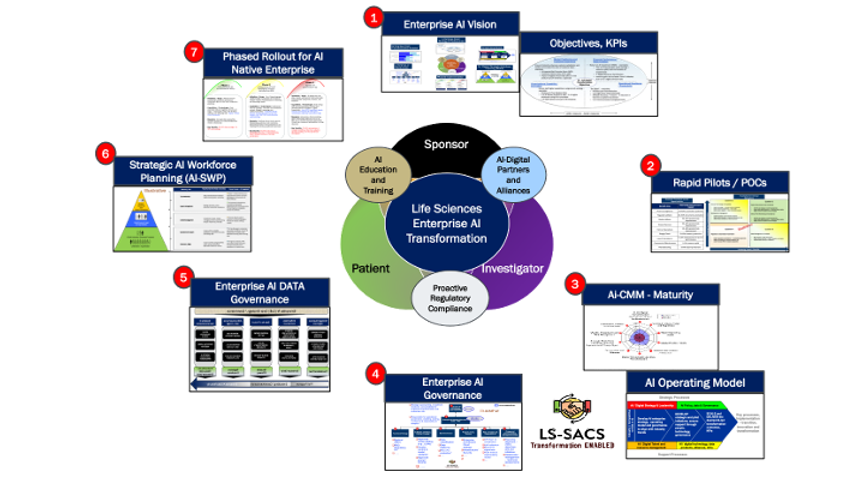
Holistic Enterprise AI Transformation
-
Define the AI transformation strategy, roadmap and clearly articulated objectives and KPIs – proactive alignment with industry trends, business strategy, value creation, and competitive differentiation.
-
Rapidly prototype and pilot AI solutions & POCs to validate business value before enterprise-scale deployment - develop investment roadmaps, business cases, and value realization plans, documented outcomes, accountable leadership, dedicated SMEs and technical team and rigorous governance.
-
Design future-state operating model and a phased roadmap aligned with best practices of Ai-Capability Maturity Model (Ai –CMM) – HITL-integrated workflows, spanning people, processes, governance, technology, data, and organizational change.
-
Establish enterprise AI governance structure including Ai-COE, decision forums, responsible AI, data & risk management, security, compliance aligned with FDA, EMA and other regulatory agencies’ evolving guidelines, GxP-ready controls and other pillars.
-
Design scalable AI and data architectures, including enterprise data foundations, RAG, agentic AI, and integration with existing business systems – Focus on “Product-centric models” for end-to-end scalability and sustainability.
-
Design Strategic Workforce Planning to fit AI (Ai-SWP) – Refine SWP to fit the needs of AI-led enterprise from roles, recruitment, training, re-training, and performance measures / rewards.
-
Lead Phased AI strategy implementation and adoption through effective program & change management, vendor management and continuous improvement.
Ai-led digital transformation strategy has to be holistic and at the enterprise level and seamlessly tied to comprehensive framework and set of metrics. For example a Balanced Score Card (BSC) can provide a practical approach for most of the KPIs along four groups that can drive tracking and monitoring through a structured governance

Enterprise Strategy and Performance using a Balanced Score Card (BSC)
Enterprise AI Maturity Assessment (Ai-CMM)

Ai-CMM assessment allows our clients to understand their vision, context, and gaps in the context of evolving industry and technology trends. It allows organizations to rapidly develop a clear strategy, operating model and phased roadmap to progress through the AI Capability Maturity Model (CMM)
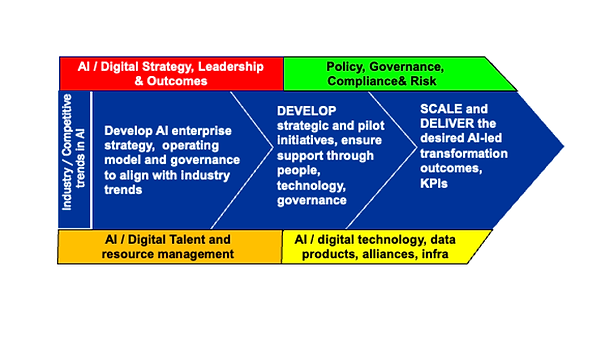
Enterprise AI Operating Model
A customized Ai-led digital operating model that includes process, roles and responsibilities, governance, digital technology and other key factors is a critical component of the transformation strategy,
Enterprise AI Data Strategy
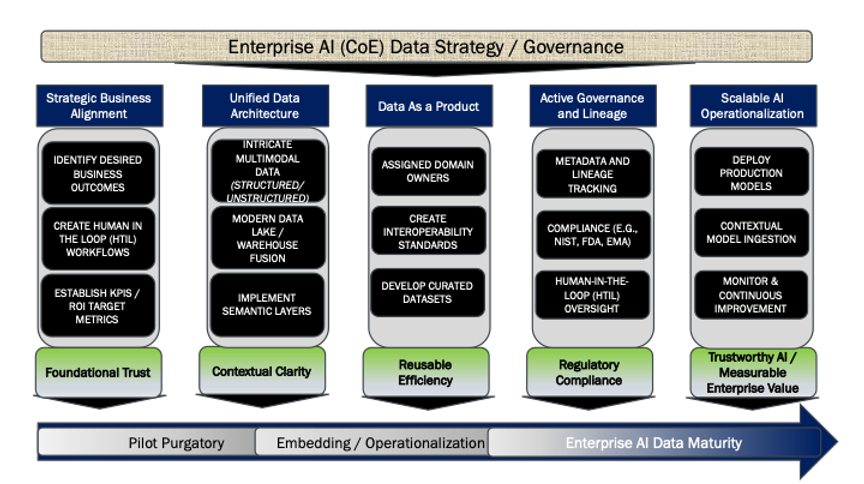
An AI Data Strategy is the foundational bedrock of any successful Enterprise AI framework. Successful AI transformation requires a modern, governed, and context-rich data foundation. It needs to be considered a core business driver sequencing the development through specific phases.
1. Strategic business alignment: Map high-value workflows to discover exactly where AI intersects with real business processes.
2. Unified architecture: Shift towards unified environments that effectively combine data lakes, traditional warehouses, and streaming pipelines, ensuring analytics tools, AI models, and business teams are all working from the exact same datasets.
3. Treating Data as a Product: Datasets are increasingly managed as reusable business assets, with clear data owners, enforcing enterprise standards for interoperability, and standardizing quality controls.
4. Implementing Lineage and Metadata: Establish strong transparency by deploying lineage and metadata management systems, providing a clear view into where the data originated, how it was transformed, and exactly where it is utilized within AI pipelines.
Redefined Digital Strategic Workforce Plan (DSWP)
Strategic Work Plan needs to be customized to meet the evolving needs of enterprise AI model, timelines, staff capabilities and training needs of the organization. As the enterprise moves through the phases of AI-led transformation, hybrid roles that overlap humans and AI need to be evaluated and staffing planned

Selection of Pilots / POCs / AI Projects
Organizations need to follow a rigorous approach in selecting pilot initiatives to ensure that they have the potential to delivery meaningful outcomes, have clarity on tools and trained staff needed for the successful implementation, and are scalable for sustainable business benefits.
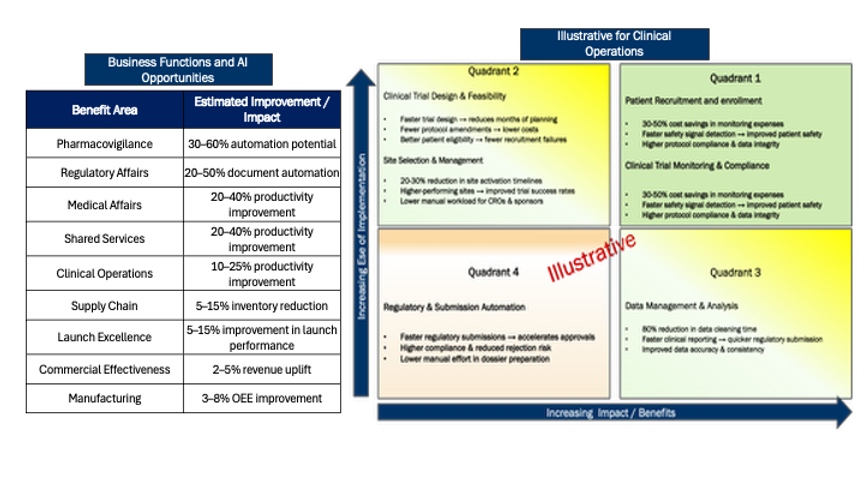
Phased Implementation Plan aligned with strategy and KPIs - Clinical Operations Illustration

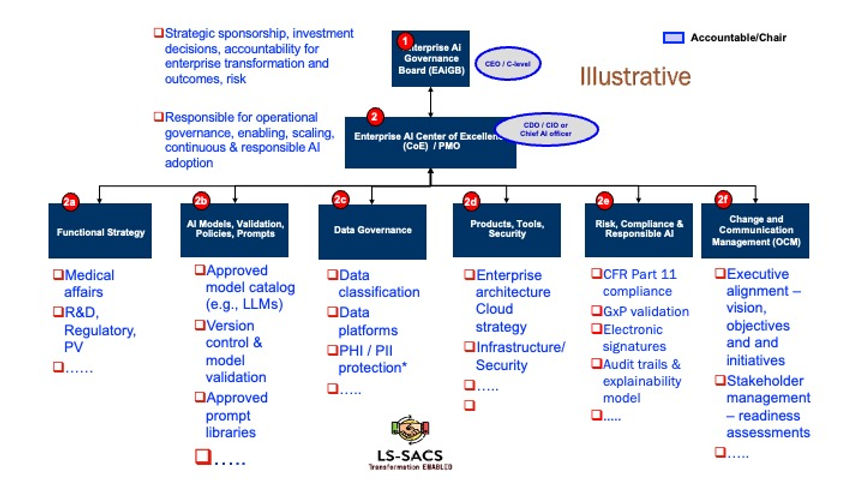
Structuring and Empowering Your AI Center of Excellence
An overarching governance that drives enterprise AI strategy and initiatives / pilot projects is critical for success. Governance should include structure, working forums, accountable and empowered leaders (RACI) and track / monitor KPIs, risks and ensure proactive mitigations.